

Jellyfish Tanks
Upside-Down Jellyfish
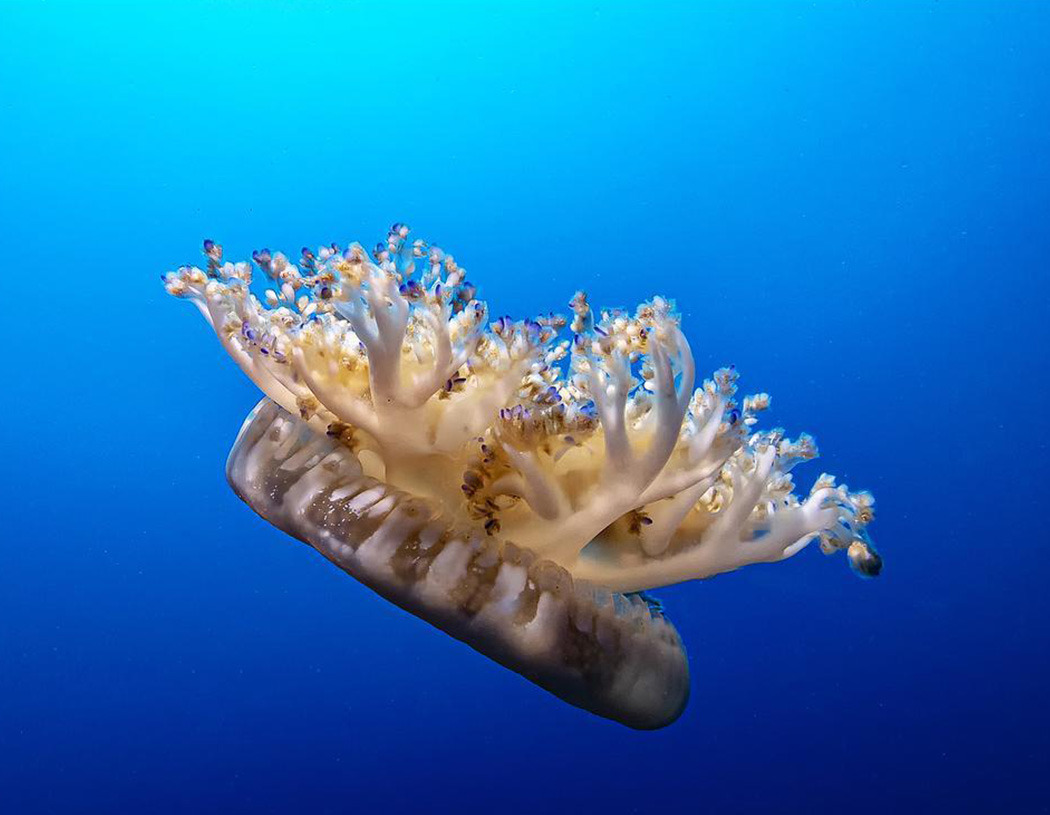
This unusual organism is the upside-down jellyfish, a curious critter that prefers to rest with its bell on the seafloor and its frilly oral arms reaching up. Native to tropical Indo-Pacific waters, it has now spread into parts of the Mediterranean Sea. This was mainly caused by ballast water, seawater taken in by ships to help them stay stable while travelling. When released at their destination, this water can carry small marine creatures into new environments.
The jellyfish is usually found in warm, shallow areas such as sandy bays, lagoons, harbours and mangroves. It pulses gently to move water around its body, helping it breathe and capture food. Its sting is mild and generally harmless to humans, causing only minor irritation.
This jellyfish’s unusual upside-down pose is part of a clever partnership with tiny algae that live inside its body. These microscopic algae use sunlight to make food through photosynthesis, like mini-solar panels, and share the nutrients with their jellyfish host. By lying with its oral arms facing the sun, the jellyfish ensures the algae get plenty of light. In return, it receives energy-rich nutrients (up to 90% of its diet) and a little help staying healthy. At night, when sunlight is no longer available, it supplements its diet by catching small animals and organic particles drifting through the water with its sticky tentacles.
Jellyfish Tanks
Upside-Down Jellyfish
This unusual organism is the upside-down jellyfish, a curious critter that prefers to rest with its bell on the seafloor and its frilly oral arms reaching up. Native to tropical Indo-Pacific waters, it has now spread into parts of the Mediterranean Sea. This was mainly caused by ballast water, seawater taken in by ships to help them stay stable while travelling. When released at their destination, this water can carry small marine creatures into new environments.
The jellyfish is usually found in warm, shallow areas such as sandy bays, lagoons, harbours and mangroves. It pulses gently to move water around its body, helping it breathe and capture food. Its sting is mild and generally harmless to humans, causing only minor irritation.
This jellyfish’s unusual upside-down pose is part of a clever partnership with tiny algae that live inside its body. These microscopic algae use sunlight to make food through photosynthesis, like mini-solar panels, and share the nutrients with their jellyfish host. By lying with its oral arms facing the sun, the jellyfish ensures the algae get plenty of light. In return, it receives energy-rich nutrients (up to 90% of its diet) and a little help staying healthy. At night, when sunlight is no longer available, it supplements its diet by catching small animals and organic particles drifting through the water with its sticky tentacles.