


Hard & Soft Corals / Natural Reefs
Common Clownfish
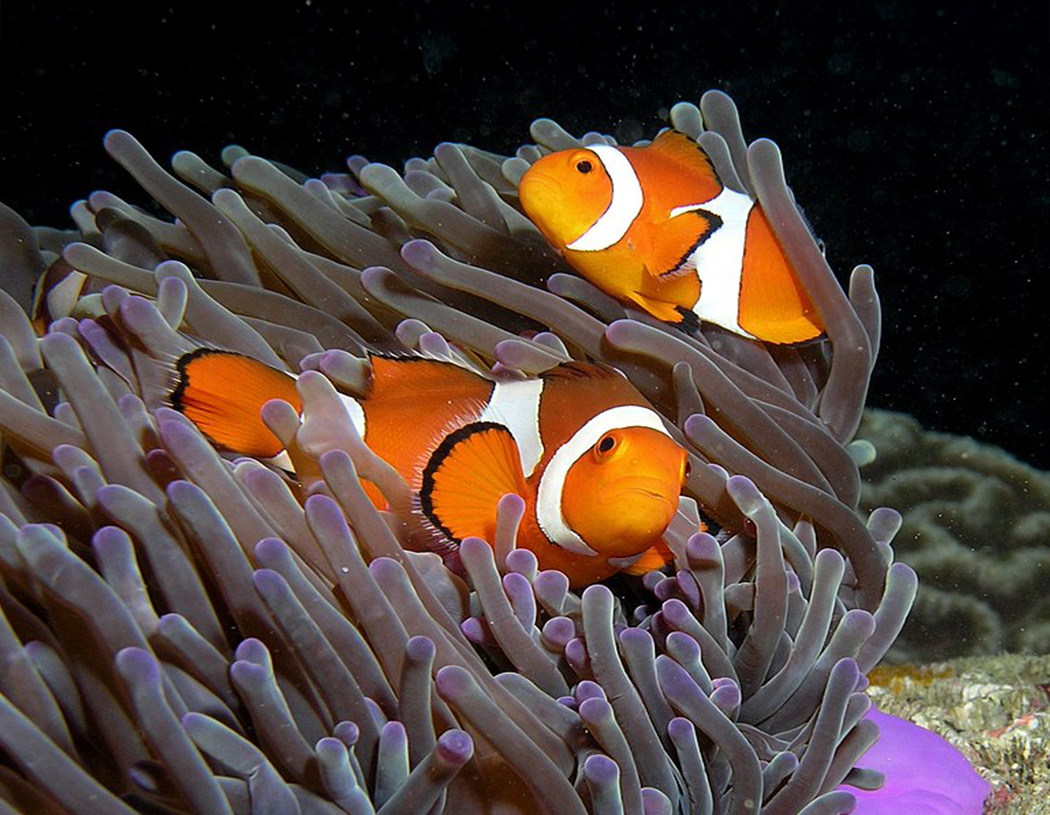
The common clownfish is a bright orange reef fish with three distinctive white bands. It lives among the stinging tentacles of sea anemones, keeping them clean by removing dirt, predators, and parasites. In return, the clownfish enjoys protection from the anemone, thanks to a special mucus layer that makes it immune to its host's sting. Before moving in, clownfish often "dance" by brushing against the anemone's tentacles to gradually acclimate and reinforce this mucus coating.
In the wild, clownfish live in family groups within a single anemone, usually led by a dominant female and her mate. They follow a strict social hierarchy: if the female dies, the largest male changes sex and becomes the new female. The breeding pair lays hundreds of tiny eggs on a flat rock near the anemone, often timed with the moon cycle. The female lays the eggs, and the male guards and fans them with his fins until they hatch about a week later.
Clownfish are omnivores, feeding on small animals, plankton, and algae. They also eat leftover scraps from the anemone's meals. While clownfish are not currently endangered, protecting reef habitats and supporting sustainable aquarium practices helps keep their wild populations healthy.
Hard & Soft Corals / Natural Reefs
Common Clownfish
The common clownfish is a bright orange reef fish with three distinctive white bands. It lives among the stinging tentacles of sea anemones, keeping them clean by removing dirt, predators, and parasites. In return, the clownfish enjoys protection from the anemone, thanks to a special mucus layer that makes it immune to its host's sting. Before moving in, clownfish often "dance" by brushing against the anemone's tentacles to gradually acclimate and reinforce this mucus coating.
In the wild, clownfish live in family groups within a single anemone, usually led by a dominant female and her mate. They follow a strict social hierarchy: if the female dies, the largest male changes sex and becomes the new female. The breeding pair lays hundreds of tiny eggs on a flat rock near the anemone, often timed with the moon cycle. The female lays the eggs, and the male guards and fans them with his fins until they hatch about a week later.
Clownfish are omnivores, feeding on small animals, plankton, and algae. They also eat leftover scraps from the anemone's meals. While clownfish are not currently endangered, protecting reef habitats and supporting sustainable aquarium practices helps keep their wild populations healthy.