


Maltese Underwater Statue of Jesus Christ
Spiny Starfish
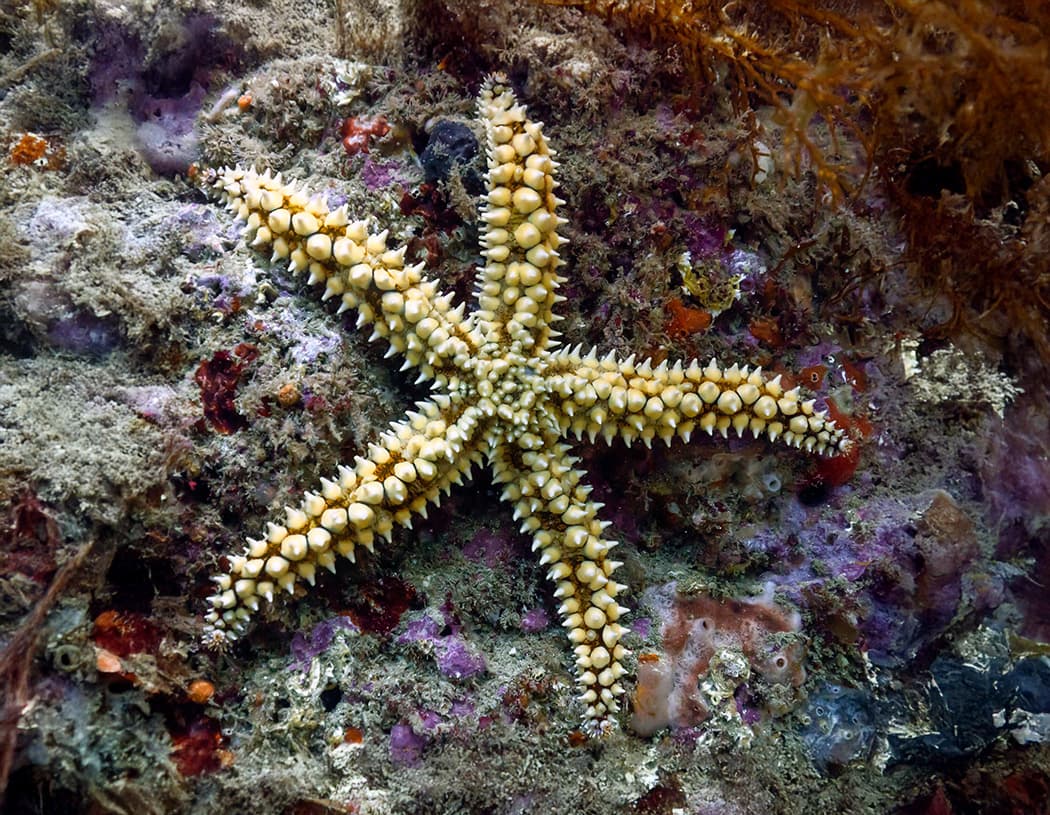
With a small central disc and five long tapering arms, the spiny starfish truly stands out on Atlantic and Mediterranean reefs. Each arm is lined with three rows of cone-like spines, usually white or pale with purple tips, and each spine is surrounded by tiny pincer-like pedicellariae that help keep its body free from debris or parasites.
This starfish thrives on both rocky and muddy bottoms. It’s a determined hunter, feeding on bivalve molluscs like mussels and oysters, as well as sea urchins, snails, and even other starfish. When it encounters a shell, it uses its tube feet to gently open it and then pushes its stomach out to digest the meal outside its body. Young spiny starfish often settle in shallow, algae-rich nursery grounds where they linger for years before moving on to deeper territories and hunting larger prey.
In late summer, they may gather in shallow waters and release eggs and sperm into the sea at the same time, triggered by rising water temperatures. Like many starfish, they can regrow lost arms, even from just part of the central disc, making them true masters of regeneration.
Maltese Underwater Statue of Jesus Christ
Spiny Starfish
With a small central disc and five long tapering arms, the spiny starfish truly stands out on Atlantic and Mediterranean reefs. Each arm is lined with three rows of cone-like spines, usually white or pale with purple tips, and each spine is surrounded by tiny pincer-like pedicellariae that help keep its body free from debris or parasites.
This starfish thrives on both rocky and muddy bottoms. It’s a determined hunter, feeding on bivalve molluscs like mussels and oysters, as well as sea urchins, snails, and even other starfish. When it encounters a shell, it uses its tube feet to gently open it and then pushes its stomach out to digest the meal outside its body. Young spiny starfish often settle in shallow, algae-rich nursery grounds where they linger for years before moving on to deeper territories and hunting larger prey.
In late summer, they may gather in shallow waters and release eggs and sperm into the sea at the same time, triggered by rising water temperatures. Like many starfish, they can regrow lost arms, even from just part of the central disc, making them true masters of regeneration.