






Maltese Underwater Statue of Jesus Christ
Spotted Weaver
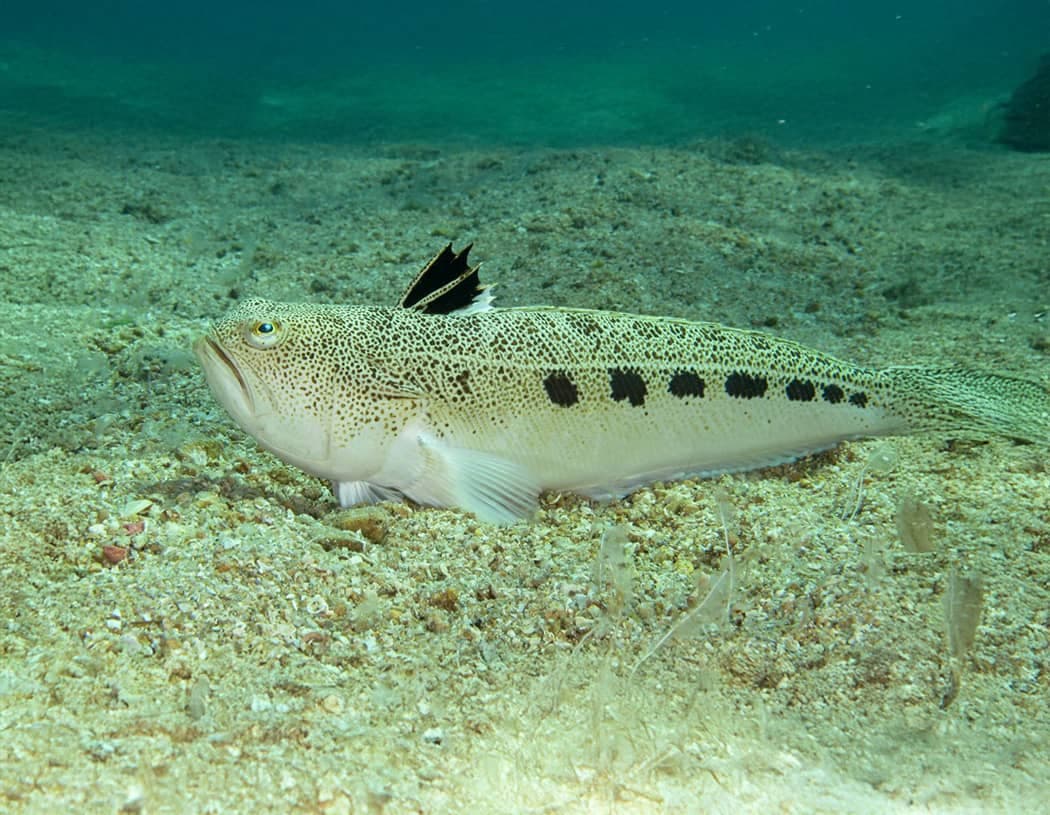
The Spotted Weever is a venomous fish found along the coasts of the Eastern Atlantic and the Mediterranean Sea. It typically inhabits shallow waters, often burrowing into the sandy or muddy seabed. This species has an elongated, laterally compressed body with a broad head and a mouth that slopes steeply upwards. Its coloration is brown and yellow on the head and back, paler below with darker spots along the sides. The first dorsal fin is black and consists of three spines, which are highly poisonous, as are the backward-facing spines on the extremities of the gill covers.
Spotted Weever feeds on small fish and crustaceans, using its venomous spines to subdue prey.
The Spotted Weever is considered one of the most dangerous weever species due to its aggressive behavior and potent venom. Divers have reported attacks in open water by large individuals and even the pursuit of diving groups. In case of encounter, it is advised to quickly move away from the territory of this species and to stay vigilant if the fish raises its dorsal fin.
Maltese Underwater Statue of Jesus Christ
Spotted Weaver
The Spotted Weever is a venomous fish found along the coasts of the Eastern Atlantic and the Mediterranean Sea. It typically inhabits shallow waters, often burrowing into the sandy or muddy seabed. This species has an elongated, laterally compressed body with a broad head and a mouth that slopes steeply upwards. Its coloration is brown and yellow on the head and back, paler below with darker spots along the sides. The first dorsal fin is black and consists of three spines, which are highly poisonous, as are the backward-facing spines on the extremities of the gill covers.
Spotted Weever feeds on small fish and crustaceans, using its venomous spines to subdue prey.
The Spotted Weever is considered one of the most dangerous weever species due to its aggressive behavior and potent venom. Divers have reported attacks in open water by large individuals and even the pursuit of diving groups. In case of encounter, it is advised to quickly move away from the territory of this species and to stay vigilant if the fish raises its dorsal fin.