



Octopus Tank
Common Octopus
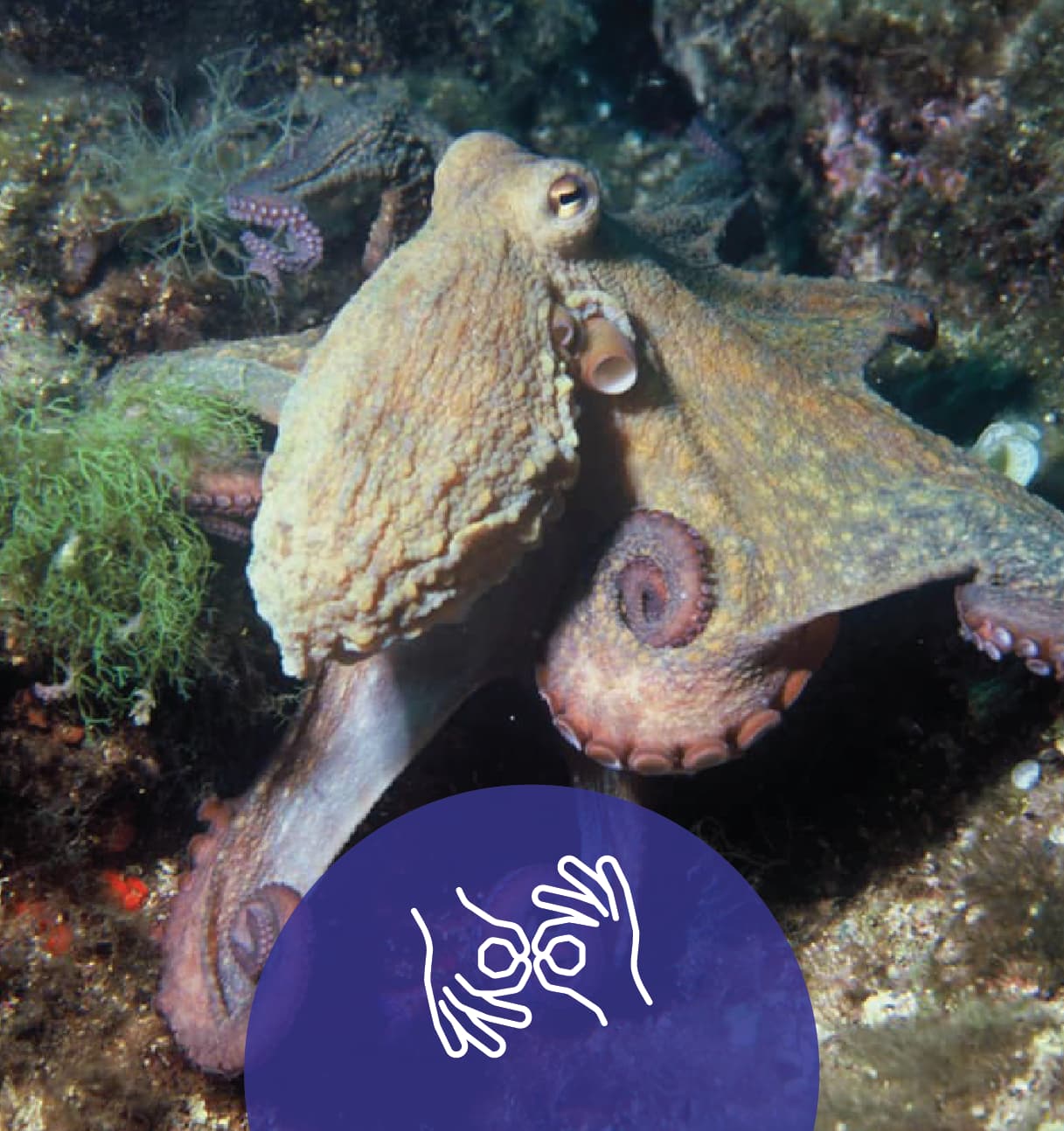
It is a clever, lone explorer of Mediterranean waters. It uses its eight flexible arms to sneak through rocky dens, then uses camouflage (changing colour and texture) to vanish like magic! It's a night-time hunter, hunting crustaceans, bivalve molluscs, and sometimes stray fish, with a hard beak strong enough to crack open shells. Their mantle can go up to 25 cm but their arms can be 1 m long.
When it’s time to make more octopuses, males use a special arm to pass sperm to the female. After she lays hundreds of thousands of eggs in her cosy den, she guards them carefully, often without eating, until they hatch. Sadly, she dies afterward.
These intelligent cephalopods live in shallow Mediterranean waters, especially around Malta’s rocky seabeds and seagrass patches, and they play a key role by keeping crab and mollusc numbers in check.
Although classified globally as “Least Concern” by the IUCN, they are heavily fished in the Mediterranean and off northwest Africa. That makes it very important to treat them with care and protect their homes.

Octopus Tank
Common Octopus
It is a clever, lone explorer of Mediterranean waters. It uses its eight flexible arms to sneak through rocky dens, then uses camouflage (changing colour and texture) to vanish like magic! It's a night-time hunter, hunting crustaceans, bivalve molluscs, and sometimes stray fish, with a hard beak strong enough to crack open shells. Their mantle can go up to 25 cm but their arms can be 1 m long.
When it’s time to make more octopuses, males use a special arm to pass sperm to the female. After she lays hundreds of thousands of eggs in her cosy den, she guards them carefully, often without eating, until they hatch. Sadly, she dies afterward.
These intelligent cephalopods live in shallow Mediterranean waters, especially around Malta’s rocky seabeds and seagrass patches, and they play a key role by keeping crab and mollusc numbers in check.
Although classified globally as “Least Concern” by the IUCN, they are heavily fished in the Mediterranean and off northwest Africa. That makes it very important to treat them with care and protect their homes.