





Indo-Pacific T34
Red Lionfish
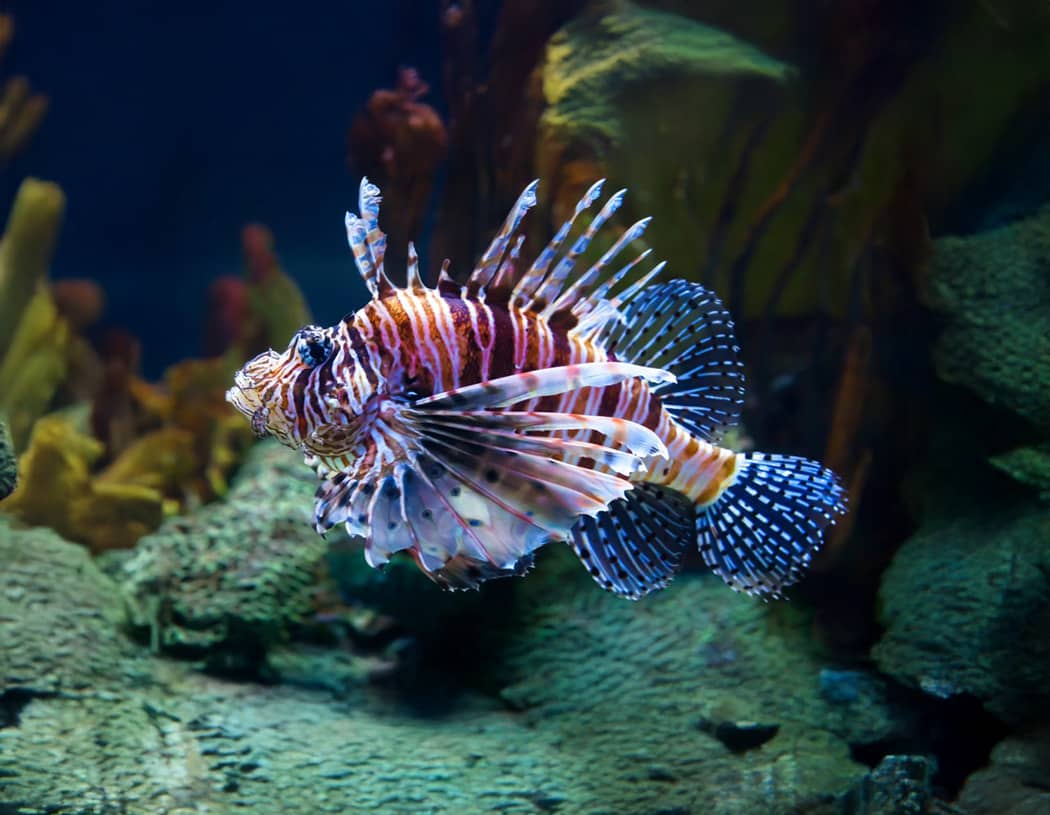
The red lionfish lives among coral reefs, rocky outcrops and lagoons in its native Indo-Pacific region. It is a solitary predator and is most active at dawn and dusk when it hunts small fish and crustaceans. During feeding, it uses its broad fins like a net to corner prey before striking with a rapid sucking motion. This hunting style, combined with its ability to consume large meals, makes it an efficient predator. Breeding occurs year-round in warm waters. Males perform courtship displays before females release floating egg clusters, which may contain more than 10,000 eggs. These hatch within a couple of days, producing larvae that drift with ocean currents before settling onto reefs. Such high reproductive potential contributes to its success as an invasive species. Outside its natural range, particularly in the Caribbean, western Atlantic, and in the Mediterranean the lionfish has become a significant ecological threat. With few predators recognising it as prey, populations grow unchecked and put pressure on native reef fish. Conservation programmes now encourage targeted fishing, with campaigns promoting lionfish as an alternative seafood to reduce its numbers.
Indo-Pacific T34
Red Lionfish
The red lionfish lives among coral reefs, rocky outcrops and lagoons in its native Indo-Pacific region. It is a solitary predator and is most active at dawn and dusk when it hunts small fish and crustaceans. During feeding, it uses its broad fins like a net to corner prey before striking with a rapid sucking motion. This hunting style, combined with its ability to consume large meals, makes it an efficient predator. Breeding occurs year-round in warm waters. Males perform courtship displays before females release floating egg clusters, which may contain more than 10,000 eggs. These hatch within a couple of days, producing larvae that drift with ocean currents before settling onto reefs. Such high reproductive potential contributes to its success as an invasive species. Outside its natural range, particularly in the Caribbean, western Atlantic, and in the Mediterranean the lionfish has become a significant ecological threat. With few predators recognising it as prey, populations grow unchecked and put pressure on native reef fish. Conservation programmes now encourage targeted fishing, with campaigns promoting lionfish as an alternative seafood to reduce its numbers.