



Big Fish
Redtail Catfish
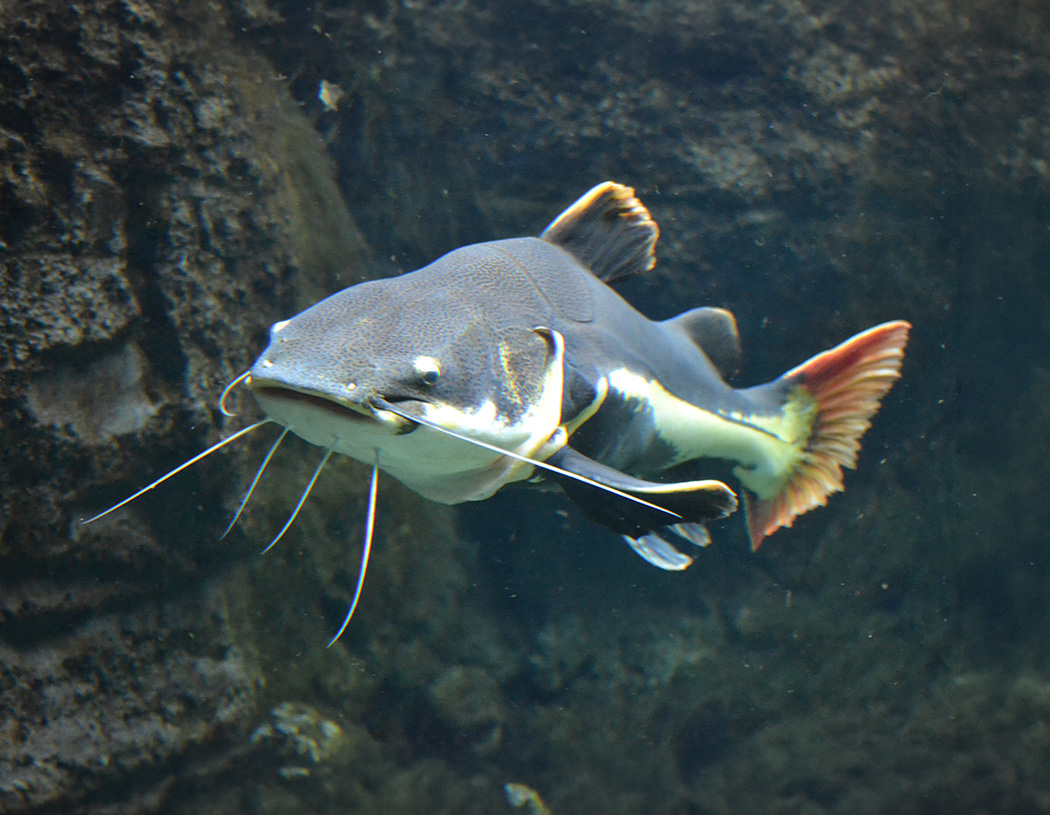
The redtail catfish is a huge freshwater fish from South America, found naturally in the Amazon and Orinoco river basins. It lives close to the bottom in large rivers, streams, lagoons, sloughs and seasonally flooded forest habitats.
It is easy to recognise thanks to its dark back, pale side stripe and bright red or orange tail. It also has long whisker-like barbels around the mouth. These barbels are not just decoration: they help the fish explore murky water and detect food by touch and smell. This catfish is a slow-moving bottom predator. It mainly feeds on fish, but it can also eat crabs, crustaceans, fruits and seeds, especially in flooded forests. Instead of chasing prey for a long distance, it often uses its senses to find the food and then ambush it.
Like many large river fish, redtail catfish release eggs and sperm into the water during spawning. After fertilisation, the young develop in the river system, where floodplain habitats can provide food and shelter.
This species is very common in the aquarium trade, but this creates serious problems. Young redtail catfish are often sold when they are only a few centimetres long, yet adults can become giants of 135 cm. Most private aquariums cannot provide the space, filtration and long-term care that such a giant needs. However, it is somewhat common in the ornamental fish trade and this can cause serious problems. In fact, when owners can no longer keep them, some redtail catfish are released into rivers, lakes or reservoirs. This can cause a serious ecological damage and should never be done. Outside its native range, a large predatory fish may eat native animals, compete with local species, spread parasites or disturb the food web.
In nature this species is not currently considered globally threatened but responsible fisheries, habitat protection and responsible aquarium choices remain important.
Big Fish
Redtail Catfish
The redtail catfish is a huge freshwater fish from South America, found naturally in the Amazon and Orinoco river basins. It lives close to the bottom in large rivers, streams, lagoons, sloughs and seasonally flooded forest habitats.
It is easy to recognise thanks to its dark back, pale side stripe and bright red or orange tail. It also has long whisker-like barbels around the mouth. These barbels are not just decoration: they help the fish explore murky water and detect food by touch and smell. This catfish is a slow-moving bottom predator. It mainly feeds on fish, but it can also eat crabs, crustaceans, fruits and seeds, especially in flooded forests. Instead of chasing prey for a long distance, it often uses its senses to find the food and then ambush it.
Like many large river fish, redtail catfish release eggs and sperm into the water during spawning. After fertilisation, the young develop in the river system, where floodplain habitats can provide food and shelter.
This species is very common in the aquarium trade, but this creates serious problems. Young redtail catfish are often sold when they are only a few centimetres long, yet adults can become giants of 135 cm. Most private aquariums cannot provide the space, filtration and long-term care that such a giant needs. However, it is somewhat common in the ornamental fish trade and this can cause serious problems. In fact, when owners can no longer keep them, some redtail catfish are released into rivers, lakes or reservoirs. This can cause a serious ecological damage and should never be done. Outside its native range, a large predatory fish may eat native animals, compete with local species, spread parasites or disturb the food web.
In nature this species is not currently considered globally threatened but responsible fisheries, habitat protection and responsible aquarium choices remain important.